First a little about myself I live on the beautiful Sunshine Coast Qld and are a passionate surfer and have been pretty much my entire life. I'm married to a great wife who has a great deal of patience especially when I feel the pressures of study and as we all know we can go a little crazy around the end of each study semester. I have two little rat bag daughters which keep me very busy but are a great deal of fun. I'm an Account Manager (Sales Rep) for a Steel distributor and basically have taken this course for a career change and to pursue teaching which I believe I have a passion for an is always an area I have wanted to pursue.
Well this is my first post as part of the course requirement for ICT's (Information Communication Technology) For Learning Design which is for my CQ University post graduate course GDLT (Graduate Diploma Learning Teaching) Secondary.
As part of my previous studies (Bachelor of Business Majoring in Business) I have created websites through the use of HTML and CSS code but I never created a blog before. I'm very interested in following the blog process and discovering new areas about my studies and myself. I have noticed some comments regarding blogs helping you along this process.

jayfab04 (2014).
Also after reviewing topic one's readings and videos for ICT's I will further elaborate on the areas I found interesting or important to furthering mine and others Teaching development.
At the recent Res School at CQ's (Central Queensland's) Rockhampton Campus I found Ragnar Purje, 2014 lecture very interesting and once again the main theme coming from his lecture along with the other lecturer's was the interaction with students is crucial to students further development. His approach to explaining to students that they have the power over them selves, as ultimately they are responsible for their own decisions. I believe is very important and will certainly help me to engage with students once they understand this and know how to implement it.
Gaining a better understanding of ICT's and how they can be used in the classroom will certainly be an asset to any teachers repertoire of skills. This is further elaborated in Topic ones readings as Brain Imagery Probes the Idea of Diverse Intelligences by Grace Rubenstein, 2009 in the article she quotes how Shaywitz, 2014 "states personalising is a key to children's development and she encourages teachers to allow kids struggling to read for example to use other forms such as dictation or pictorial storyboards. She also urges educators to encourage and promote other skills as kids with reading disabilities will be strong in creative and visual areas". From this I gather that although all children will have strengths and weaknesses it will be a huge focus area for the teacher to tailor their approach on the students strengths whilst combining this with the students weaknesses subtly to further develop their areas for improvement. ICT's will certainly be a great tool that plays to a students other censors like visual and orally whilst the key will be linking the ICT back to a traditional or more practical task such as reading.
After viewing the film How The Brain Learns Best Edutopia Webinar (2010) I was not fully aware of the RAS (Reticular Activating System) Willis (2013) before and what an important part it played in a students awareness in the classroom and in life. Gaining this understanding on the RAS and how information is interpreted by the brain will be an area I will need to be conscious of when teaching in the classroom. Also with better understanding of the RAS I will be able to interpret and understand certain students reactions to tasks also to gain students attention and interest during activities. The film also reminded that I will need to be getting feedback from the students on their progression during classes regularly on activities. The example used of the whiteboard in the video is certainly a good way to receive feedback from students so you can again tailor your teaching methods to the individuals learning abilities. It also considered the hidden areas of the classroom like shyness, social status which always needs to be considered when trying to gain interaction from the students. I believe this method would make most students provide answers as it would help to alleviate the concerns students may have when being asked to provide answers.
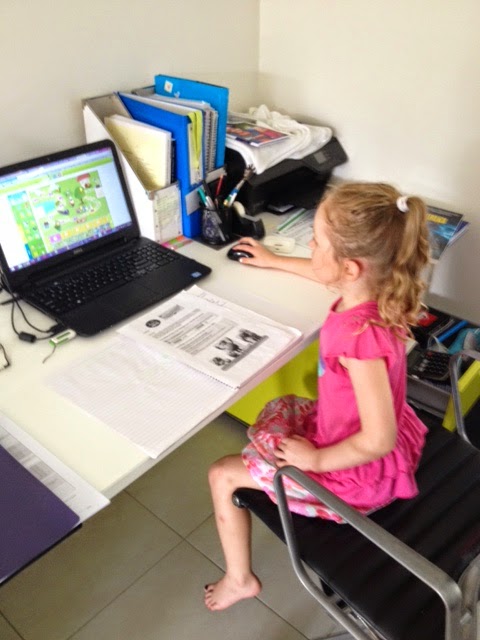
On the subject of ICT's I thought I would include a picture of my five year old daughter Rubi who started Prep this year and she is using a website application called http://readingeggs.com.au/ which is combing a visual, audio ICT to help develop her readings skills.
Anyhow its Sunday afternoon and I'm off to enjoy a cold one with the neighbours.
If you find anything interesting in my blog please don't hesitate to make a comment or please email me at patrick.mcnally@cqumail.com
Week 1
Posted; 08.03.2015.
References:
ABC. (2014) Reading Eggs. Retrieved from http://readingeggs.com.au/
Edutopia Webinar. (2010, May, 10). How the Brain Learns Best: Strategies to Make Learning Stick [Video file].Retrieved from https://www.youtube.com/watch?v=eMZnfFD1maU
Jayfab04. (Bloggist). (2014, Sept 25). Mass Comm
Evolved: Mass Communication & its History, The Importance &
History of Mass
Communication [Picture], Retrieved from https://justinthomas94.wordpress.com/2014/09/25/the-importance-history-of-mass-communication/
Purje, R. (2014). Responsibility theory® (who's got the power?)® : an exciting new approach in personal and classroom behaviour management. [Nerang, Queensland] Purje Publications, 2014.
Rubenstein, G. (2009). Brain Imagery Probes the Idea of Diverse Intelligences. Retrieved from
http://www.stumbleupon.com/su/2tQutL/www.edutopia.org/multiple-intelligences-brain-research
Shaywitz, S.E. (2014). The Yale Centre for Dyslexia & Creativity.
Retrieved
from http://dyslexia.yale.edu/About_ShaywitzBios.html
Willis, J. (2013). Better Teaching: Why You Bore Students &
What You Can Do About It.Retreieved
from http://www.teachthought.com/learning/better-teaching-why-you-bore-students-and-what-you-can-do-about-it/
